Article
Why MedTech Teams Slow Down as Software Grows and What Better Architecture Looks Like

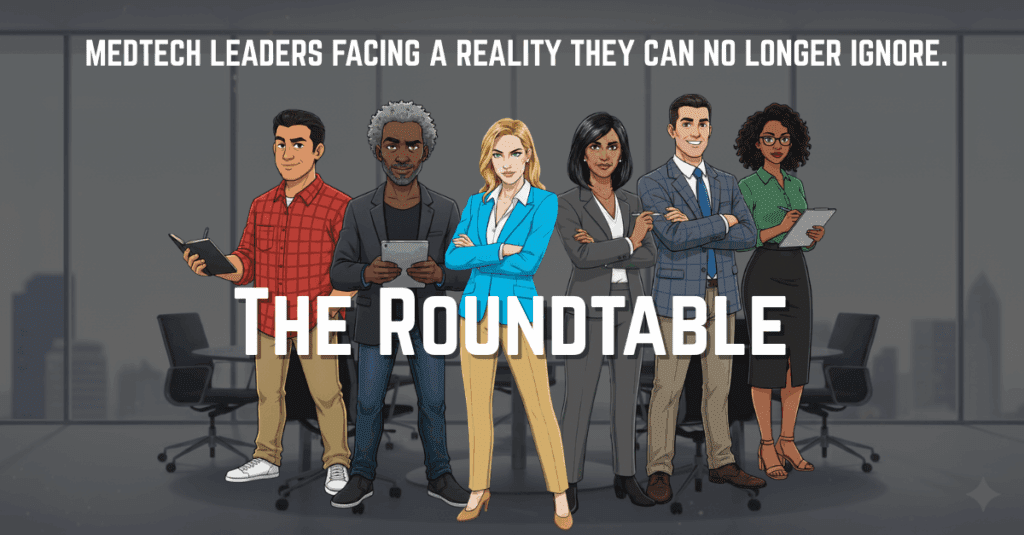
The coffee in my mug was cold, a bitter reminder that I’d been staring at out five-year roadmap since sunrise. But that comes with being the CEO. I, Claire, looked at the diagram on my screen, the one Javier sent me months ago, showing a web of interconnected services. We were still a straight line, a hardware company in a world that wanted a partner.
The board wasn’t just asking about the algorithm anymore; they wanted to know why our “world-class” hardware was being treated like a commodity. I could hear Omari’s voice in my head before he even walked in, defending the sanctity of his code. But technical superiority doesn’t pay the bills if the customer can’t see the value beyond the box. Today’s meeting wasn’t about features; it was about survival. We had to decide whether to build an ecosystem or watch our market share erode one “anemic” quarterly report at a time.
“It’s not just a ‘connected app,’ Omari. It’s an infrastructure play,” said Javier Vargas, our VP of Software. He leaned over the conference table, looking like he’d spent the night debugging more than just code. “We’re building a digital environment that connects the device to services and data platforms”.
“Infrastructure is a cost center, Javier,” snapped Omari Jackson, our CTO. He paced the small boardroom with his usual dismissive energy. “Our predictive engine is the crown jewel. You want to surround it with… what? Bluetooth handshakes and cloud storage? We’re surgeons of data, not plumbers”.
Priya Sharma, our CFO, cleared her throat. “The ‘plumbing,’ as you call it, is what allows us to move from one-time device sales to recurring revenue”. She tapped a pen against her tablet, her gaze literal and blunt. “SensiTech isn’t beating us on hardware specs. They’re beating us on ‘lifetime value.’ I can’t quantify ‘superiority,’ but I can quantify a digital subscription service”.
“And I can’t sell a black box anymore,” interjected David Kincaid, our CRO. “I was with the procurement head at Mercy yesterday. She didn’t ask about our sampling rate. She asked if our data could feed directly into their surgical planning workflow”.
“And did you tell her that would require a complete overhaul of our cybersecurity and data architecture?” asked Nia Washington, our VP of Quality & Regulatory. “You can’t just ‘plug in’ to a hospital environment without a validated integration strategy. We have regulatory obligations and design controls to think about. This isn’t a consumer fitness tracker”.
I leaned forward. “Nia’s right about the complexity, but David’s right about the demand. We’re losing ground because we’re selling a ‘box’ while the market is buying ‘outcomes’”.
“So what’s the proposal?” Omari asked, stopping his pacing to look at me. “We stop being a device company?”
“No,” Javier countered, his tone calm. “We become a service company that uses a device as the sensor. Think about the organ perfusion example. They struggled selling the hardware, but they exploded when they sold the transport and logistics services”.
“That requires a digital ecosystem,” I said, pointing to the screen. “It’s the device, the mobile layer, the cloud backend, and the third-party integrations”.
“And the data strategy,” Omari added, his tone shifting slightly. “If we’re going to do this, we can’t treat the data as exhaust. We have to design that in intentionally”.
“Exactly,” Javier said. “But we don’t have to build it all from scratch. We can leverage existing smartphone platforms for the patient interface and focus our internal resources on the core clinical development”.
“Wait,” Priya interrupted. “If we use third-party platforms, who owns the relationship? Who owns the data?”
“The ecosystem is fluid, Priya,” Javier explained. “We can be part of their environment while they use our services. It’s about being where the patient and clinician already live”.
Nia sighed as she scribbled a note. “If we’re moving to a service model, our QMS needs to reflect continuous software delivery, not just ‘big bang’ releases. We’ll need to modernize our development foundations, or the technical debt will kill us”.
“I can’t sell a ‘roadmap’ to the board,” Priya warned. “I need to see how this solves the reimbursement hurdle. How does this prove the therapy works?”
David leaned in. “By tracking usage in real-time, just like the CPAP manufacturers did with cellular connectivity. They proved compliance to solve reimbursement before it was even a ‘strategy’”.
The room went quiet for a moment. The tension hadn’t vanished. Omari still looked protective of his algorithms, and Nia was clearly calculating the documentation hours, but the direction had shifted.
“Alright,” I said, standing up. “Javier, I want a breakdown of what we ‘plug into’ versus what we build to stay capital-efficient. Omari, I want you and Nia to look at how we turn that ‘black box’ into a data asset without losing our regulatory discipline”.
“This is going to be expensive,” Priya noted, though she didn’t look as displeased as usual.
“Being irrelevant is more expensive,” I replied.
We weren’t there yet. We still had an outdated cloud platform and a sales team trained to sell hardware, not digital insights. But for the first time in months, we weren’t just arguing about the engine. We were finally talking about the car.
Related Posts
Article
Why MedTech Teams Slow Down as Software Grows and What Better Architecture Looks Like
Article
What Actually Works in MedTech, According to Industry Leaders
Article
Roundtable Chapter 2 – The One With the Bottleneck at the Finish Line
Article
Roundtable Prologue – The One Where the Algorithm Couldn’t Sell Itself

