
CEO & Founder, Ketryx
Erez Kaminski

On this page
For MedTech software teams, the important AI question today is not whether a model can write code. It is whether AI can help make compliance, testing, traceability, and quality review better by making compliance, testing, traceability, and quality review continuous throughout the software development lifecycle (SDLC).
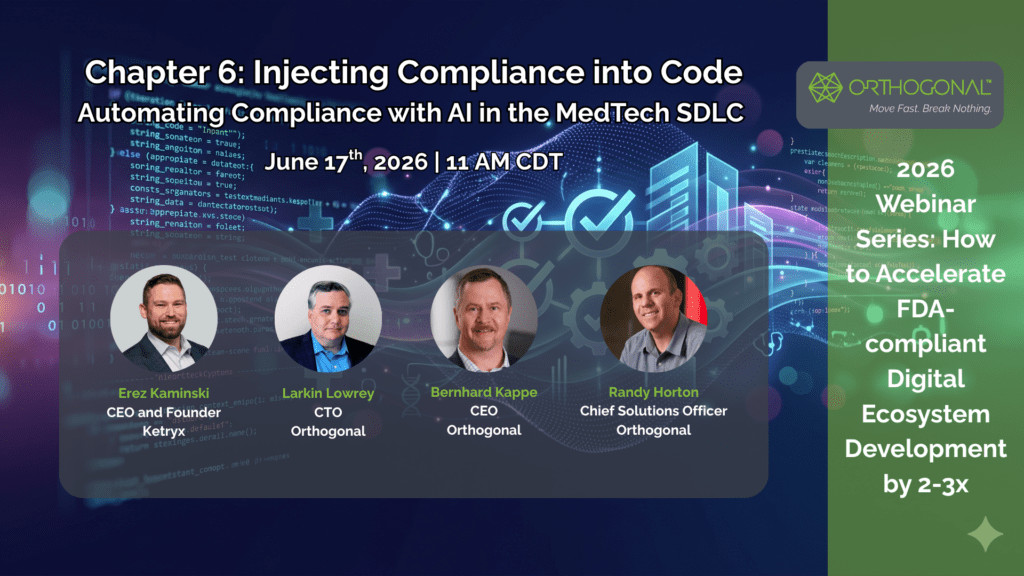
That was the focus of Orthogonal’s webinar. The panel discussed how generative AI and agentic systems are changing the development of Software as a Medical Device (SaMD), connected medical devices, mobile apps, cloud services, and embedded systems.
The panel argued that AI-assisted work should operate within the same design controls that govern the rest of the development process. When requirements, risk controls, tests, and other lifecycle artifacts are connected, agents can help maintain traceability, review documentation, identify inconsistencies, and surface missing evidence.
The goal of using this AI is not to replace human judgment. It is to create a development process in which compliance evidence is continuously maintained, quality issues are identified and addressed earlier, and experts spend more time on the key tasks of risk, architecture, and clinical context.
The panel also emphasized that AI development and quality practices commonly used in consumer and enterprise software cannot simply be ported to medical devices. The discussion noted that error rates or failure modes acceptable in lower-risk applications become far less tolerable when software affects patient care. AI-enabled workflows in MedTech require purposeful validation, governance, and human oversight.
For MedTech organizations, the question is where AI can provide measurable value and how to introduce it responsibly.
Rather than treating compliance as a separate activity that happens after development, the webinar emphasized that compliance work should be integrated into the development process itself.
In many organizations, engineering creates the product while quality and regulatory teams assemble the evidence around it. Requirements, test results, risk controls, traceability, reviews, and documentation may live in separate tools or documents. When teams prepare for a release, audit, or submission, they spend time reconnecting two disparate sets of information that should already be linked.
That becomes harder as the product grows more complex.
AI and automation enable a different model. Instead of rebuilding compliance evidence at the end of a development phase, teams can create and maintain it from the artifacts produced during the lifecycle.
The panel discussed several examples:
For SaMD and MedTech teams, this matters because the lifecycle must produce both a functioning product and the evidence demonstrating that it was developed under appropriate controls. Those controls sit at the center of our medical device software development services, with or without AI in the product.
Human review remains necessary. The difference is that quality and systems experts can spend less time locating disconnected information and more time deciding whether the evidence supports the right conclusion.
AI changes how software engineers, systems engineers, quality professionals, and regulatory teams contribute to product development.
Traditionally, MedTech professionals often measure their contribution by the artifacts they create: specifications, designs, code, test plans, traceability matrices, and quality documents.
Agentic AI changes the economics of that equation.
As agents take on more drafting, analysis, review, and execution work, the human role shifts toward defining objectives, setting constraints, providing context, and evaluating results. Value comes less from producing every artifact manually and more from ensuring the outcome is safe, useful, and verifiable.
The panel described a rapid progression in how AI is used in software development:
This does not mean engineers, quality professionals, or systems engineers become people managers. It means their work starts to resemble the management of a digital workforce. It means they spend less time producing routine artifacts and more time defining goals, giving agents the right context, reviewing the outputs, and deciding whether the result is safe, useful and acceptable.
The Orthogonal Agentic AI Playbook breaks these changes down role by role, for engineering, product, SDET, quality and leadership teams.
Agentic AI is making guardrails more important, not less. As software teams outside regulated industries experiment with AI agents, many are discovering that agents perform better when the work is bounded by clear requirements, intended behavior, and acceptance criteria.
This is familiar territory for MedTech.
The panel argued that MedTech may be better prepared than many industries to apply AI in medical device software development because design controls already provide a structured way to define what the product should do, how it should behave, what risks must be managed, and how the team will verify that the work meets its intended purpose.
Outside of regulated environments, teams are learning that agents perform poorly when they receive vague instructions. To build or modify a feature safely, an agent needs a clear description of intended behavior, relevant constraints, and acceptance criteria.
MedTech teams already work with many of the input elements that AI agents need:
The panel also noted that modern prompting guidance often resembles systems engineering guidance. Both rely on defined users and system interactions, intended use, constraints, boundaries, and expected behavior.
That does not mean every existing design-control system is ready for AI-enabled work. Requirements can still be ambiguous, inconsistent, incomplete, or too focused on implementation details. Those weaknesses limit how effectively agents can support development.
Still, the discipline of design controls and systems engineering provides a strong foundation. When teams define intended behavior, safety boundaries, and acceptance criteria clearly, they create a stronger basis for code maintenance, bug remediation, test generation, requirements analysis, and documentation review.
A common assumption is that agents need extremely detailed, implementation-level requirements to produce reliable results.
The panel argued that this approach can actually be counterproductive.
Instead, requirements should be detailed enough to define the behavior and constraints that matter for safety, performance, and reliability. They do not need to prescribe every internal design or implementation decision.
Overly prescriptive requirements can shift attention from the outcome that needs to be achieved to the mechanism used to achieve it. They can also make requirements harder to maintain because design changes may trigger unnecessary document changes.
The panel recommended focusing requirements on:
For example, a requirement may specify that an alarm condition must be detected within a defined time and that the user must receive a notification in a particular way. It does not necessarily need to dictate the internal algorithm unless the implementation itself is safety critical.
This gives agents room to help solve the problem while keeping the work inside a clear, testable, and reviewable framework.
Once the work is bounded by design controls and clearer requirements, AI can begin to support the quality, systems engineering, and regulatory activities that surround development.
Software engineering has long used techniques such as regression testing, integration testing, continuous integration, test-driven development, behavior-driven development, and automated test execution to find defects earlier.
The panel argued that AI can support quality, systems engineering, and regulatory work in a similar way: not by replacing experts, but by helping them review, compare, and analyze lifecycle artifacts more efficiently. Our webinar Agentic AI for MedTech: From Requirements to Tested Software walks through an example: an agent producing acceptance criteria, building software from them, and testing whether the resulting behavior matches.
This is not a criticism of quality, systems engineering, or regulatory professionals. It reflects a practical limit: no individual can maintain awareness of every relationship across a large set of requirements, specifications, risk records, tests, and related documentation.
The panel separated AI-supported quality review into two categories.
An agent can help assess whether a design input, risk record, specification, or quality document is clear, internally consistent, and complete enough for its intended purpose. It can flag ambiguous language, missing information, or unsupported assumptions before the work moves further through the lifecycle.
An agent can also analyze relationships across large sets of requirements, specifications, risk controls, and test records. It can surface potential conflicts, detect traceability gaps, or flag risk controls that lack corresponding verification activities.
Again, the value is not that AI replaces the expert. The expert spends less time on manual comparison and more time evaluating whether the system is correct, complete, and appropriate for its intended use.
AI performs best when lifecycle information is stored in connected artifacts and structured data rather than scattered across disconnected documents.
Post-market surveillance was one example discussed in the webinar. AI can help teams identify trends, recurring issues, and potential safety signals. But those insights only create value if the organization can connect them back to requirements, risk controls, design decisions, and verification activities.
When lifecycle information is fragmented across separate documents and systems, assessing the impact of a finding and implementing the right change becomes more difficult.
Organizations that manage lifecycle information through connected artifacts can maintain stronger links across:
Those links support impact analysis, traceability review, and change management.
The panel reported that some organizations using these approaches have reduced documentation effort, shortened software release cycles, improved detection of traceability gaps, and experienced fewer software defects in production.
These outcomes are not guaranteed. They illustrate what can happen when AI and automation operate on connected lifecycle artifacts rather than disconnected manual processes.
The panel also noted that R&D and post-market activities represent only part of the effort required to bring a medical product to market. Clinical studies, regulatory submissions, reimbursement, commercialization, and broader healthcare-system processes remain significant contributors to cost and schedule.
AI is well suited to processing and organizing large amounts of information. It can draft content, compare records, identify patterns, and synthesize information across requirements, specifications, tests, and lifecycle data.
Engineers, quality professionals, systems engineers, and product teams remain responsible for the areas where context, judgment, and trade-offs matter most.
Decisions about architecture, clinical context, acceptable risk, and whether a product is safe and effective still require human domain expertise. These decisions often involve ambiguity and competing priorities that cannot be resolved through the pattern matching alone that AI excels at.
The panel described this partly as an economic shift. As AI reduces the cost of prediction, analysis, and information synthesis, teams gain access to more information and more possible courses of action. That increases the importance of judgment because engineers and subject matter experts still need to decide which actions are appropriate and which risks are acceptable.
For MedTech teams, this changes how different functions spend their time:
AI can increase the amount of work a team can review. It does not transfer accountability for decisions that affect product safety, effectiveness, or regulatory compliance.
The webinar explored whether easier code generation changes the need for or the value of iterative development.
The panel’s answer was no.
Agile originally emerged because product development involves uncertainty. Teams learn through implementation, testing, user feedback, risk analysis, and changing technical conditions. Those realities do not disappear because coding becomes faster.
What changes with the advent of Agentic AI is the cost of experimentation.
When the coding effort decreases, teams can evaluate more ideas, eliminate weak options earlier, and use the results to improve requirements and specifications.
That enables shorter feedback cycles:
The panel also discussed simulation. In MedTech, simulation has often been useful but expensive to create and maintain across multiple products. AI may reduce the effort required to build simulations from requirements, CAD models, and related artifacts, allowing teams to evaluate behavior earlier and bring those findings back into the design process.
The point is not to reduce planning. It is to tighten the connection between planning, development, testing, and learning.
The webinar also addressed a practical challenge for connected device teams: the large number of edge cases created by mobile applications, Bluetooth communication, device interfaces, operating system updates, cloud systems and changes to communication protocols.
A domain expert may have deep knowledge of a specific technology. However, no individual can continuously track every internal lesson learned, platform update, protocol revision, published issue, and real-world usage condition that could affect product behavior.
An agent can extend that expert’s reach by combining internal product knowledge, relevant external technical information, and product-specific requirements and constraints. It can help identify potential edge cases earlier so the human expert can evaluate them before formal verification, validation, or field testing.
That same approach applies across connected MedTech systems, including SaMD products that depend on mobile applications, cloud services, device interfaces, bring-your-own-device environments, and data exchanges.
Using AI within a regulated SDLC presents a different validation challenge than using a conventional software tool with fixed functionality.
Traditional validation often assumes that a tool can be validated, documented, and reassessed when a new version is released. That approach was already becoming harder to apply to cloud services, mobile operating systems, and other platforms that change continuously.
Agentic AI introduces additional variables of complexity to the challenge of tools validation. For the product side of that work, see our verification and validation services.
For example, the underlying model may change. Prompts and context may change. The intended use of the agent may expand. Outputs may differ across executions. An agent that performs well in one environment may behave differently after changes to surrounding systems, data sources, or workflows.
The panel emphasized risk-based approaches to tools validation that include:
The discussion also introduced the concept of “agent factors.”
Human factors engineering helps organizations understand how users, clinicians, and engineers interacting with a system make mistakes, misinterpret information, become distracted, and respond to interfaces and workflows. Those insights help teams design systems and processes that reduce foreseeable use errors and mitigate human limitations.
Agent factors applies a similar lens to AI agents.
The idea is to study how agents behave, where they are likely to fail, and what controls are needed to manage those failures. Agents can resemble humans in some ways because LLMs are trained on human-generated language and can mimic patterns of human reasoning and communication. But agents also behave differently from people. They can process more context, operate faster, and generate outputs at a scale humans cannot match. They also have failure modes that differ from human failure modes.
An agent may use incomplete context, operate outside their intended scope, take unanticipated actions, or generate plausible output that fails a required criterion.
That is why agent factors should be incorporated into the risk model for AI-enabled development.
Continuous validation helps teams determine whether an AI-enabled workflow continues to perform as expected over time. Structural safeguards answer a different question: how do you keep a probabilistic system operating within a defined development process?
The panel used the term “symbolic quality assurance” to describe deterministic checks that can be applied to AI-generated work.
Those checks can verify whether:
These checks do not make an LLM deterministic. The model may still generate different wording, different reasoning paths, or different proposed outputs across runs. What becomes deterministic is the layer of verification around the model. The system can objectively check whether required traceability links exist, whether required lifecycle activities were completed, whether evidence is present, and whether the output satisfies predefined structural rules or acceptance criteria.
The goal is not to use AI to skip testing. It is to increase the scope and frequency of testing and verification. The panel described a model in which a team may perform fewer manual test executions while increasing requirements coverage, automating more tests, and running those tests more often. Building that capability is the focus of our work on testing automation for regulated software.
From a quality perspective, broader coverage and more frequent execution are more meaningful indicators of rigor than the raw number of manually executed test steps.
The webinar did not recommend an organization-wide transformation all at once.
Instead, the panel recommended starting with a limited use case that demonstrates measurable value and expanding based on the results.
One option is to apply AI across the full lifecycle of a small product line or a software-focused product line with frequent releases. This creates a controlled environment for evaluating the approach, measuring outcomes, and refining processes before broader adoption.
Another option is to introduce AI into workflows one at a time across multiple products. Initial use cases might include:
The appropriate starting point depends on where the organization spends significant manual effort and where improvement can be measured using defined metrics.
The first step should not be selecting a tool. It should be defining a specific use case with a known problem, clear constraints, measurable success criteria, and a review process that matches the associated risk.
One of the webinar’s key themes was that AI agents do not automatically understand how a MedTech organization performs its work. An agent needs a clearly defined role and operating context.
Teams need to define:
This work often exposes knowledge that exists only in the experience of engineers, quality professionals, systems engineers, regulatory specialists, and other subject matter experts rather than in documented processes. New employees may learn that knowledge through training and collaboration with colleagues. An agent requires explicit instructions and access to relevant context.
Well-defined agent personas can also become reusable assets that capture how an organization performs requirements analysis, quality review, test design, regulatory drafting, and systems engineering.
Requirements, acceptance criteria, risk controls, traceability, and verification evidence provide the structure agents need to support regulated development. Write requirements around outcomes, constraints, and acceptance conditions rather than unnecessary implementation details.
Documentation, traceability, test evidence, and quality review should be connected outputs of the lifecycle, not manual activities performed after development is complete.
AI is well suited for large-scale review, cross-system consistency checks, traceability analysis, submission drafting, and other tasks that require synthesizing information across many artifacts.
Engineers, quality professionals, systems engineers, product teams, and clinical experts remain responsible for risk decisions, clinical context, architecture, and final judgment. AI-enabled workflows require ongoing validation, drift monitoring, and deterministic controls around traceability, process execution, and required evidence.
Begin with a bounded product line or high-friction workflow, prove value, and expand based on evidence. Define agent personas with clear roles, context, boundaries, and review expectations before scaling their use.
By producing and maintaining compliance evidence from the artifacts created during development, rather than reassembling it before a release, audit or submission. In practice that includes drafting regulatory submission content from source documents, generating and reviewing design-control and QMS artifacts, maintaining traceability as requirements, code, tests and risk controls change, identifying missing evidence, and detecting functions that may not have been implemented. Human review is still required; what changes is that experts spend less time locating disconnected information.
Yes, in two ways. An agent can analyze relationships across large sets of requirements, specifications, risk controls and test records to surface conflicts, detect traceability gaps, or flag risk controls that lack corresponding verification activities. Separately, deterministic checks can be run around that work to verify that required traceability links exist, that required lifecycle activities were completed and that required records and evidence are present. The expert still decides whether the traceability is correct and appropriate.
Validating an AI-supported workflow differs from validating a conventional tool with fixed functionality, because the model, the prompts, the context and the intended use can all change, and outputs may differ across executions. Risk-based approaches discussed in the article include continuous validation of AI-supported workflows, computer software assurance practices, representative evaluation datasets, monitoring for performance drift and periodic review of high-risk AI use cases. Alongside that, deterministic checks can confirm that an agent output conforms to structural rules or acceptance criteria before it moves further through the lifecycle.
Decisions about architecture, clinical context, acceptable risk, and whether a product is safe and effective. These involve ambiguity and competing priorities that cannot be resolved by pattern matching alone. Engineers, quality professionals, systems engineers, product teams and clinical experts remain accountable for them. AI can increase the volume of work a team is able to review; it does not transfer accountability for decisions that affect product safety, effectiveness or regulatory compliance.
See how Orthogonal approaches AI-enabled medical device software development, from first prototype through to post-market change.
CEO & Founder, Ketryx
Erez Kaminski

CTO, Orthogonal
Larkin Lowrey

CEO & Founder, Orthogonal
Bernhard Kappe

Chief Solutions Officer, Orthogonal
Randy Horton
Related Posts
Talk
The MedTech AI Factory: From Algorithm Discovery to Compliant Deployment

Talk
Agentic AI for MedTech: From Requirements to Tested Software

Talk
MedTech Ecosystem Design Controls: Move Faster With the Right Level of Compliance

Talk
Beyond the Device: Where Digital Ecosystems Are Creating Real Value in MedTech

