Article
What Actually Works in MedTech, According to Industry Leaders
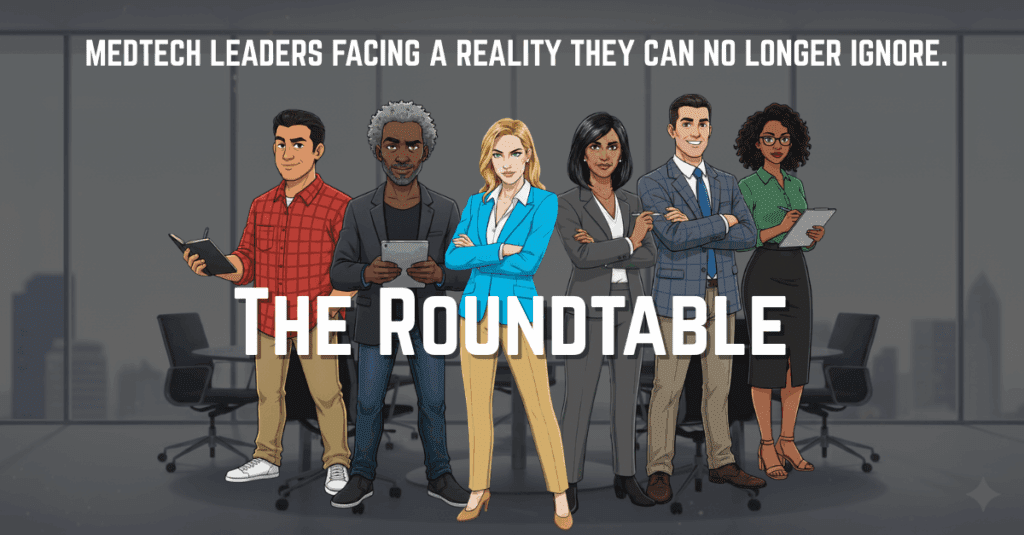
The air in the boardroom was thick with the scent of burnt coffee and the looming shadow of a missed milestone. On my monitor, the project dashboard for our second-generation diagnostic suite was a sea of yellow and red. We were supposed to be “Agile”. That was the word Javier had used to sell the board on our new development speed. But as Claire Adams, the CEO, I was looking at a team that had sprinted for six months only to hit a brick wall of documentation and regulatory review at the very end.
We were building a connected ecosystem that lived on patient smartphones and integrated with hospital clouds. It was exactly what we needed to fight SensiTech, but our speed had created a massive pileup. We were running in fast software circles inside a rigid, phase-gated cage. I looked at the team, ready for the inevitable finger-pointing to begin.
“We finished the feature set three weeks ago,” said Javier Vargas, our VP of Software, his sarcasm sharper than usual. He gestured at the dashboard. “The code is stable. The integrations are live. But we’re sitting on our hands because the paperwork is stuck in a 1990s-style review cycle.”
“That paperwork is your Design History File, Javier,” countered Nia Washington, our VP of Quality & Regulatory. “You’ve been building in sprints, but you haven’t been documenting in them. Now I have a mountain of risk updates and a traceability matrix that looks like a bowl of spaghetti. I can’t sign off on a submission based on ‘trust me, it’s Agile’.”
“Nia’s right,” added Priya Sharma, our CFO. “If we miss this release window, the recurring revenue we promised the board becomes a recurring liability. Moving faster doesn’t mean anything if the release is stuck in internal purgatory.”
“The market doesn’t wait for your QMS to catch up,” interjected David Kincaid, our CRO. He looked exhausted. “Our pilot sites at Mercy are asking for the new workflow updates we promised. SensiTech is already shipping updates every six weeks because they’ve figured out how to make their regulatory team part of the team, not a toll booth.”
Omari Jackson, our CTO, leaned back. “It’s a structural failure. We’re treating software like it’s a physical production line. You can’t plan a software update like you’re pouring a concrete foundation. Software is change. We need feedback loops that actually loop, not just crash into a wall at the end of the quarter.”
“Exactly,” Javier said, jumping on the opening. “We need to integrate Nia’s team into the sprint. We shouldn’t be reconciling risk en masse at the end. We should be evaluating cybersecurity and regulatory impact as the features are implemented.”
Nia adjusted her glasses. “If you want me in the room, you have to change how you work. I can’t review a vibe. I need structured feedback. We need to right-size our processes so compliance evidence is generated alongside development, not reconstructed like an archaeological dig after the fact.”
“And we need real-world data,” Omari added. “Not just gut feelings from the devs. We need to use product analytics to see how clinicians are actually using the pilot. Where they’re hitting errors and where the friction is. That data should feed directly back into our risk files.”
“Wait,” Priya interrupted. “Does fast feedback mean we’re releasing every two weeks? Because the hospitals will kill us if we push updates that frequently. They have IT protocols and training to deal with.”
“That’s a critical distinction,” I said, stepping in. “An internal increment for learning isn’t the same as a release to a patient. We need the capability to be fast internally so we can be disciplined and high-quality externally.”
“So, the goal isn’t just speed,” David summarized. “It’s decision quality. We use these loops to catch usability gaps and safety risks early, while they’re still manageable.”
“Alright,” I said, the path forward finally coming into focus. “Nia, I want you and Javier to pilot a cross-functional team. No more hand-offs. I want regulatory and quality review happening inside the sprint cycle. Omari, get the analytics hooked up so we stop guessing what the users need.”
“It’s a big shift in ownership,” Nia warned. “It means development has to care about documentation, and I have to care about velocity.”
“If we don’t align,” I replied, “we’ll just keep building the fastest car in the world, and then parking it in the garage because we forgot to check the tires.”
Related Posts
Article
What Actually Works in MedTech, According to Industry Leaders
Article
Roundtable Chapter 1 – The One Where the Device Was Only Half the Story
Article
Roundtable Prologue – The One Where the Algorithm Couldn’t Sell Itself

Article
Managing Emerging Risks in SaMD: Strategies for 2025 and Beyond

