
Article
Roundtable Chapter 2 – The One With the Bottleneck at the Finish Line
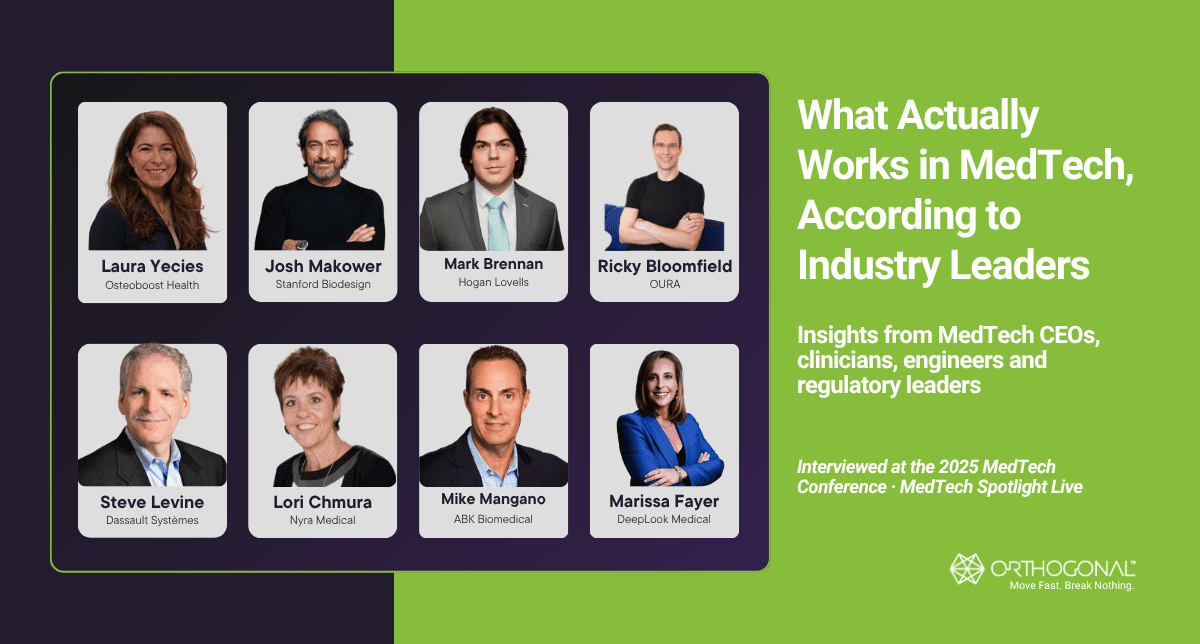
At last year’s MedTech Conference in San Diego, Orthogonal hosted MedTech Spotlight Live, a series of short, unscripted interviews with people on the front lines of healthcare innovation. These weren’t rehearsed demos or pitch-deck walkthroughs. They were candid conversations with founders, engineers, clinicians, and regulatory leaders sharing what they’ve learned, often the hard way, about making digital health solutions work in clinical settings.
You can view all the interviews from this series below:
The best products don’t ask clinicians to change behavior. They meet them where they already work.
Teams are gaining traction by embedding functionality directly into imaging platforms, point-of-care systems, or PACS viewers. A recurring pattern: when a radiologist or physician pauses on an image or hesitates over a decision, these tools offer instant, actionable insights, often with just one click.
No extra logins. No new windows. No new training.
It’s not just about delivering value. It’s about delivering it in context.
Several innovators focused on making hidden information visible, particularly in imaging scenarios such as breast, liver, and lung diagnostics, where dense tissue can obscure pathology.
These teams aren’t building new scanners. They’re using algorithms to surface information that’s already present in the image, but not reliably visible to the human eye. In one case, clinicians can verify treatment targeting immediately after delivery, rather than waiting months for tumor response. In another, mathematical overlays help radiologists distinguish subtle lesions that would otherwise blend into dense tissue.
Precision isn’t just about better tools. It’s about better timing.
AI came up in every interview, but not as a headline, and not for novelty’s sake.
Instead of chasing generative bells and whistles, successful teams are focused on what actually works:
AI isn’t the differentiator anymore. What matters is whether it holds up clinically, operationally, and legally.
Teams that are moving quickly through regulatory pathways aren’t just regulatory ready. They’re regulatory fluent.
That means:
Some of these choices led to early designations. Others prevented costly rework that could have added more than a year to the timeline.
Speed isn’t about skipping steps. It’s about doing them in the right order.
Multiple leaders described an intentional decision to focus their product narrowly, on one modality, one procedure, or one clinical segment.
This constraint wasn’t a limitation. It was a lever.
By focusing, they could:
Platform thinking can come later. To achieve early-stage success, teams win by solving a single, specific clinical problem with extreme clarity.
Emotional intelligence, including how teams communicate, build trust, and manage ambiguity, came up repeatedly across the interviews.
In product design, that means centering human factors and patient experience, not just functionality. In company-building, it means hiring for curiosity, adaptability, and collaboration, not just credentials.
The ability to stay calm in times of uncertainty and solve problems collaboratively is becoming just as important as technical skills. Teams that invest in these “soft” skills are delivering harder, faster outcomes.
Innovation is the expectation. The edge comes from how well you execute.
Across all eight conversations, the most successful teams were:
These aren’t visionary promises. They’re practical moves. And they’re what’s separating momentum from noise in MedTech right now.
Looking to accelerate your FDA-compliant digital ecosystem development by 2-3x?
For 15 years, we’ve partnered with dozens of clients, including Medtronic, Johnson & Johnson, Google, Novo Nordisk, Tandem Diabetes Care, Transmedics, Oura, Eli Lilly, and others to build SaMD and connected device solutions. This work has consistently shortened product development life cycles, improved delivery predictability, and created engaging user experiences.
Related Posts
Article
Roundtable Chapter 2 – The One With the Bottleneck at the Finish Line
Article
Roundtable Chapter 1 – The One Where the Device Was Only Half the Story
Article
Roundtable Prologue – The One Where the Algorithm Couldn’t Sell Itself

Article
Managing Emerging Risks in SaMD: Strategies for 2025 and Beyond

