Article
AAMI Publishes TIR115: New Guidance for Using Public Cloud Computing in Medical Devices


For decades, medical device quality rested on a quiet assumption: the manufacturer controls the device. It controls the hardware, the software, and every change to either. Validation, change control and submissions were all built on that assumption.
Public cloud computing broke it. A device function running in the cloud depends on infrastructure the manufacturer does not operate, and the provider changes that infrastructure continuously, sometimes without notice.
AAMI TIR115:2026, Guidance for the appropriate use of public cloud computing to enable medical device functions, is the industry’s answer for the cloud. But in writing it, our working group found something larger. The real subject wasn’t the cloud. It was indirect control: what happens when a device depends on computing someone else runs and changes. And that pattern is now everywhere.
Four ideas run through TIR115. Stated generally, they apply to any dependency a manufacturer doesn’t fully control.
Applied to the cloud, these ideas are now guidance. Applied elsewhere, they are a way of thinking that teams can use today, before any technology-specific guidance exists. TIR115 itself points the way: its list of out-of-scope topics (Annex E) names applying its principles to smartphones, clinical-system integration and AI/ML as possible future work.
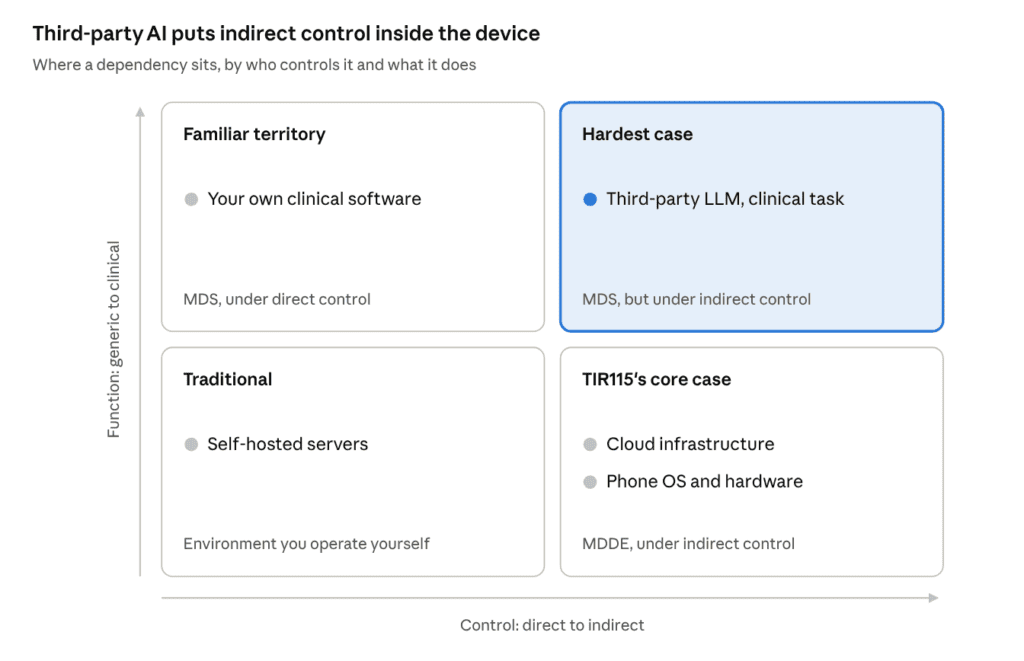
TIR115 addresses the lower right: generic infrastructure under indirect control. Third-party LLMs doing clinical work sit in the upper right, the quadrant existing frameworks cover least.
When a medical device app runs on a patient’s own phone, the manufacturer controls the app and very little else. The operating system updates on the phone owner’s schedule. New hardware ships every year. Permissions, background execution rules, Bluetooth behavior and app store policies all change without the manufacturer’s input. TIR115’s SpiroBreath case study (Annex D) recalls an earlier era, when a manufacturer could tell a clinic by agreement not to install OS updates until it had tested them. Patients’ own phones offer no such lever.
The paradigm maps cleanly:
Many teams already do some of this informally. The paradigm makes it deliberate and documented, which is what reviewers and auditors look for.
For the cloud, the paradigm has a comfortable answer. Delegate generic infrastructure to the provider and keep the clinical function under your own control. As Randy Horton has put it, you can hand the cloud provider low-level functions, but you shouldn’t let it decide when it’s a heart attack. TIR115 makes the same point with a wearable defibrillator (section 5.1): real-time detection can’t depend on a cloud resource, while retrospective analysis of the same data can.
A third-party large language model breaks that comfort. When a device uses a model it calls through an API, the component under indirect control may be doing the clinical work itself: summarizing a record, drafting a recommendation, interpreting a patient’s words. That puts something inside the MDS that the manufacturer still can’t fully control. The cloud case mostly avoids that combination: TIR115 expects supplier-controlled cloud resources to sit in the MDDE, and treats one inside the MDS as possible but less likely (Annex D, FAQ 1).
Three properties make it harder still:
The paradigm still gives teams a place to start:
This thinking complements, rather than replaces, FDA’s frameworks for AI-enabled devices, such as predetermined change control plans. Those frameworks address changes the manufacturer plans. Indirect control addresses changes someone else makes.
The four ideas say what to think about. Teams also need repeatable ways to analyze and monitor risk when a dependency can fail or change underneath them. For the cloud, those patterns are well established. For smartphones, they are taking shape. For agentic AI and LLMs, the industry, including us, is still working them out.
Top-down hazard analysis starts from what can harm a patient. On its own, it struggles with a system built from dozens of services, each of which can be slow, unavailable, wrong or changed by its provider. What works for cloud systems is to pair it with a bottom-up design FMEA (DFMEA) for each module and service.
This follows the same logic as FDA’s guidance on interoperable medical devices and on multiple function device products: analyze each interface or function on its own, then assess how its failure affects the functions around it. It is also how cloud-native design already works. Health checks, timeouts, circuit breakers, bulkheads and observability are mitigations that make failure modes visible and keep them contained. The DFMEA turns those engineering patterns into risk management evidence, and because each service has its own analysis, the risk file follows the architecture. When a provider changes a service, the team updates that service’s DFMEA and checks whether the residual effect it passes up has changed.
On a patient’s phone, the manufacturer can’t test every combination of hardware, OS version and settings before release. The pattern that generalizes is field-level self-validation: the app checks, while running, that the conditions it depends on still hold, such as the OS version, permissions, background execution, Bluetooth connection and notification delivery, and tells the user or care team when they don’t. Monitoring those checks across the installed base shows when a new OS release starts causing trouble, often before support calls do. The same DFMEA approach applies, with the phone and its OS treated as a dependency whose failure modes the app must detect.
For agentic AI and LLMs, there are not yet generalizable patterns as mature as the cloud DFMEA or smartphone self-validation. Several are emerging from our own work with multiagent systems and from conversations across the industry:
These patterns apply most directly to agentic AI used to build device software. How far they carry over to an LLM performing a clinical function inside the device is still open. [An industry working group on risk management for agentic AI is forming to take up both questions.]
Whatever your device depends on, the same four questions apply:
Teams that can answer these clearly for the cloud are well placed to answer them for phones and AI models next.
Orthogonal co-chaired the AAMI working group that wrote TIR115. We help MedTech teams apply its principles wherever indirect control shows up, starting with a cloud readiness assessment and extending to smartphone apps and third-party AI models.
TIR115 addresses public cloud computing and lists these extensions as out of scope (Annex E). Applying its principles to smartphones and AI models reflects the authors’ views, not AAMI guidance.
AAMI TIR115:2026: Guidance for the Appropriate Use of Public Cloud Computing to Enable Medical Device Functions
Published by the Association for the Advancement of Medical Instrumentation (AAMI), TIR115 provides guidance for managing public cloud computing used to support regulated medical device functions.
Related Posts
Article
AAMI Publishes TIR115: New Guidance for Using Public Cloud Computing in Medical Devices
Article
Your Next AI Algorithm May Not Be the Hard Part

Article
How MedTech Teams Must Evolve for the Agentic AI Era
Article
Why Ecosystem Design Controls Are Really About Moving Faster With the Right Rigor

