
VP, Regulatory & Quality, Orthogonal
Megan Graham

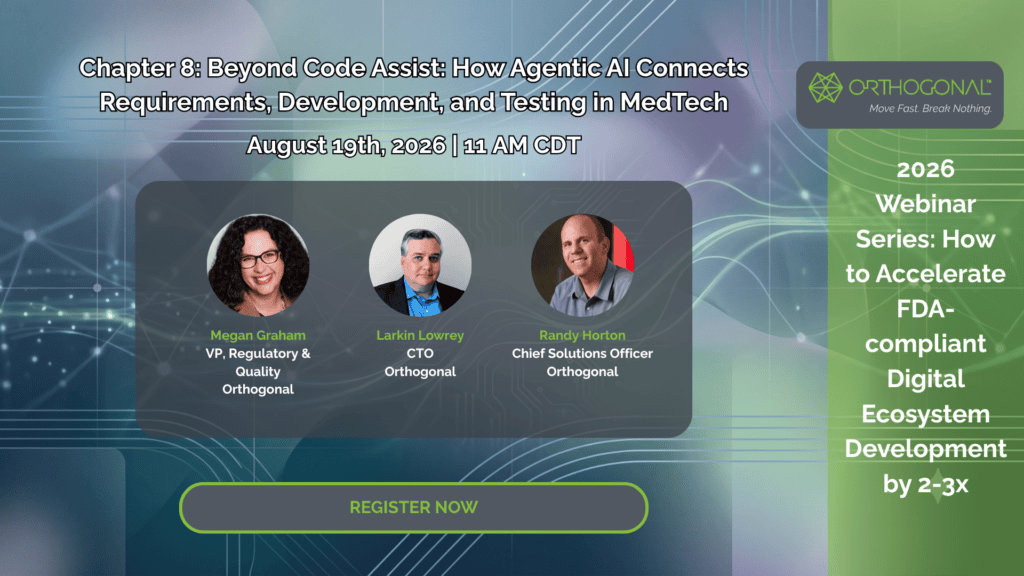
AI can help developers write code faster, but the greater opportunity for MedTech is connecting product intent to clear requirements, working software, and reliable testing to achieve 2-3x gains across the entire product development lifecycle.
Behavior-Driven Development (BDD) provides a practical structure for agentic workflows. Using testable acceptance criteria written in Gherkin, teams can define expected software behavior in a format that product, engineering, quality, and regulatory stakeholders can understand and review.
Join Orthogonal for an illustrative example of how an AI agent can help produce acceptance criteria, build software from them, and test whether the resulting behavior matches the original intent. We will also examine where product knowledge, risk decisions, validation, and human judgment must remain in control.
If your organization is considering how agentic AI could fit into its MedTech software development process, this session offers a concrete starting point for connecting human decisions to AI-supported requirements, development, and testing.
VP, Regulatory & Quality, Orthogonal
Megan Graham

CTO, Orthogonal
Larkin Lowrey

CEO & Founder, Orthogonal
Bernhard Kappe

Chief Solutions Officer, Orthogonal
Randy Horton
Related Posts

Talk
MedTech Ecosystem Design Controls: Move Faster With the Right Level of Compliance

Talk
Injecting Compliance into Code: Automating Compliance with AI in the MedTech SDLC

Talk
Beyond the Device: Where Digital Ecosystems Are Creating Real Value in MedTech
Talk
Cloud-Native Architecture (What You Should Learn from Amazon, Google and Microsoft for MedTech)

